
Why an EMS benefits from an independent failsafe layer, and how local grid-limit monitoring can trigger corrective action.
Sites with strict grid limits need more than good energy management. An independent failsafe layer provides an additional way to intervene when normal control falls short. It reduces the risk of problems, without guaranteeing that every exceedance can be prevented.
Grid limits are relevant across Europe. The terminology and consequences differ by country, operator and connection. Examples include:
These are not identical penalty systems. Base each site's settings on its own import and export permissions, measurement intervals and contractual conditions.
An EMS helps respect these limits through peak shaving and coordinated control of batteries, chargers and other equipment. But a battery may respond incorrectly, communication may fail, a large consumer may start unexpectedly, or software may contain a bug. Available battery power and energy are also finite.
Even one 15-minute outage in a 365-day year corresponds to 99.99715% availability:
(1 − 15 / 525,600) × 100 ≈ 99.99715%.
That single incident can still cause an excessive peak. High availability therefore does not guarantee compliance with grid limits.
A practical solution starts with a suitable energy meter at the site's grid connection. The meter monitors power locally and, when an intervention threshold is reached, activates an output that operates a relay or an approved equipment shutdown input.
Grid meter → local threshold detection → relay or shutdown input → selected equipment.
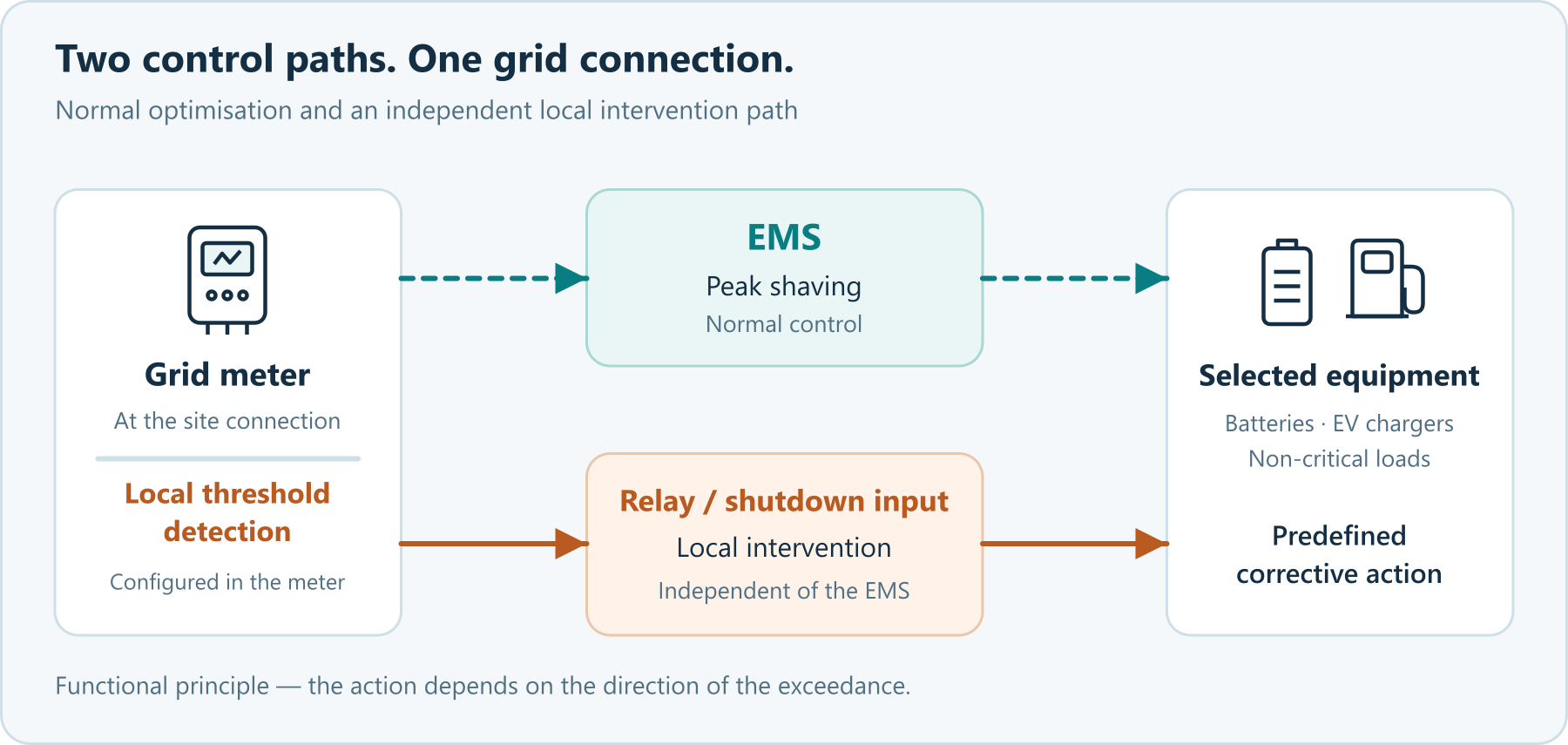
This can stop a non-critical consumer or a group of consumers that may be disconnected in an exceptional situation. The intervention must remain effective if the normal EMS control path fails. A second rule in the same EMS does not provide that independence.
Choose a meter with the required power-alarm function: an energy pulse output alone is insufficient. Its output controls appropriately rated switching equipment, rather than directly switching a high-power load.
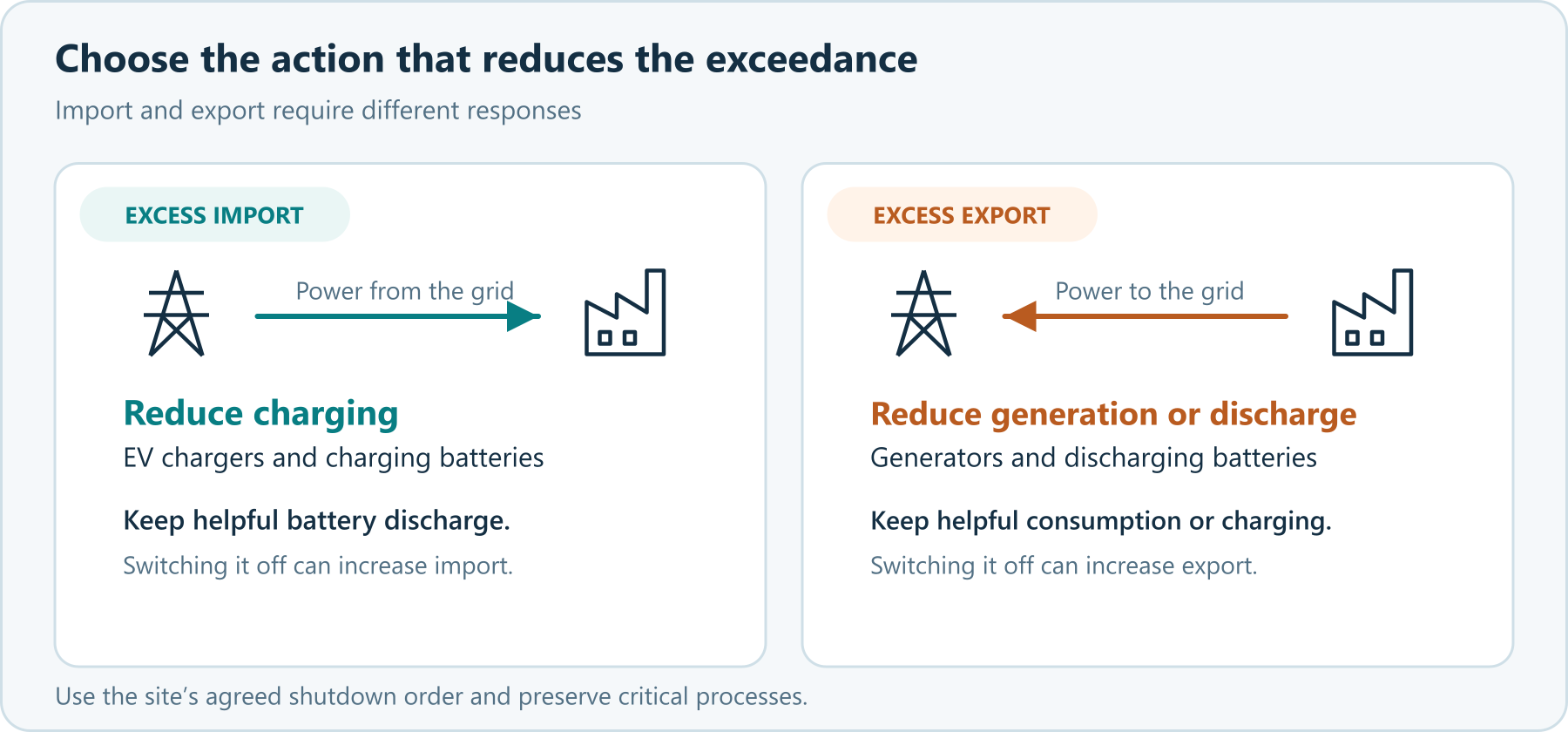
For excessive import, stopping EV charging or battery charging is often a sensible first step. Other non-critical loads can follow if necessary. However, switching off a battery that is already discharging to support the site increases import and can make the problem worse.
For excessive export, reduce generation or battery discharge. Disconnecting consumers or stopping a battery that is absorbing surplus generation can instead increase export.
Agree the shutdown order with the site operator, preserve critical processes and ensure that enough controllable power is available to bring the site back within its limit.
Illustrative import scenario: a site has a 100 kW limit. A local alarm at 95 kW for 1 s stops an EV charging group drawing 22 kW. At an unchanged site load of 96 kW, this reduces import to approximately 74 kW. Monitor total active power at the grid connection and verify the CT ratio, phase assignment and import sign first.
The 5 kW margin and 1 s delay are examples, not universal settings: allow for the largest load step, meter response and shutdown time. These examples use instantaneous power; the contractual averaging interval remains a separate consideration.
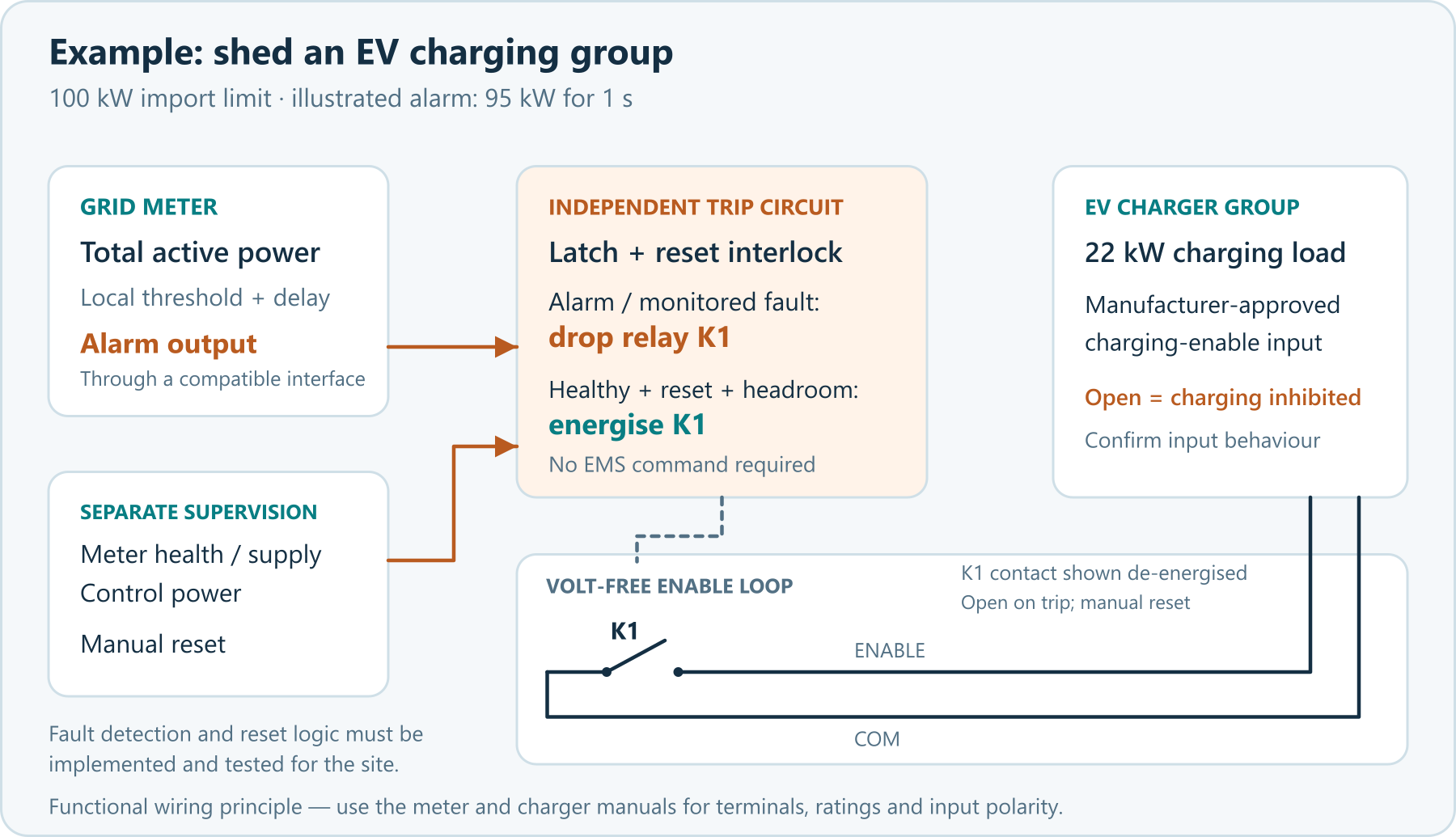
Use a compatible interface between the meter output and the trip circuit. A transistor output is not a volt-free relay contact. The illustrated circuit latches the shutdown until a manual reset with sufficient headroom; a cleared meter alarm must not automatically restart all chargers. A simple alarm output alone does not detect loss of meter power or every measurement fault: provide and test separate fault supervision or a validated healthy-permit signal.
See the Janitza manual, digital outputs and comparators, pp. 42–44 and 80–87.
See the Siemens manual, integrated I/Os and limit values, pp. 97–98 and 105–106.
See Schneider's alarm settings, output settings and output behaviour explanation.
See the Socomec manual, alarm configuration and physical output activation, sections 9.1 and 9.3.
Commissioning check: test the threshold with a controlled load or secondary injection, confirm that actual grid import falls, and repeat with EMS communications disconnected. Test loss of meter/control power and the manual reset. Re-enable charging only when the available headroom also covers the load being restored. For export, use a separately validated directional alarm and curtail generation or discharge; do not reuse this import shutdown action.
Set the intervention threshold with sufficient margin for measurement and switching delays. Account for whether the limit concerns instantaneous power, phase current or an average over the operator’s specified measurement interval. Design a defined fallback response for loss of measurements or control power, and prevent repeated on/off cycling with suitable release conditions and a controlled restart.
Have a qualified installer design and test the complete chain, including the actual equipment response. Repeat functional tests periodically and after relevant installation changes.
An ordinary meter relay is not automatically a certified safety function and does not replace required electrical protection. Where the risk or connection requirements demand it, a specialist must assess a dedicated protection relay or safety PLC as part of the complete design.